Because he’d never kept them, Gene Kannenberg Jr. stopped making New Year’s resolutions, but at a 2015 New Year’s Day party at an art gallery, he got inspired. He’d wanted to draw again. He went home, sketched a quick and sloppy comic and made a resolution: One drawing every day.

He posted his first drawing on Facebook, then another one the next day, and the next. His friends encouraged him. Within the week he’d started a
Tumblr page for his daily drawings.
About five months into his year of daily drawings, he put together
Comic Machine, a printed minicomic of some of his favorite pieces. That attracted more attention, including a shout out as a
notable comic of 2015 by the Comics Studies Society.
Next came
Comics Machine #2, then
Qodèxx, which Gene will introduce to the general public at Creative Coworking this month, on Saturday, July 29.
You’re invited. Details and RSVP at
https://qodexx.eventbrite.com.
I prodded Gene a bit and this is what I learned:
Tell me more about your day job.
My official title is Research and Media Assistant for the
Melville J. Herskovits Library of African Studies at Northwestern University. I work on social media, handle research requests for rare and archival materials for visiting scholars, and fulfill requests for scholars who wish to reproduce images from our collection in their own publications, especially from our photograph collections.
But that just scratches the surface. The Herskovits is a destination for scholars -- and dignitaries --- from around the world, so I’m also involved in creating exhibits and displays on any number of African-related topics, sometimes with very little notice. We've been visited by Ashanti chiefs from Ghana, a Supreme Court Justice from South Africa, and the daughter of a Liberian President, just to mention a few of our more notable non-scholarly visitors.
I also work with the larger library at Northwestern. Two years again I co-curated a large exhibition of cartoon art from across the Library's various collections, which led me to interview one of our alums a few months ago, the sports cartoonist and journalist Murray Olderman, who donated his papers to University Archives.
Little known fact: The Herskovits itself holds a large and growing collection of comics and graphic novels from and about Africa, so that's an area I'm learning more about every day.
What inspired you to become a comic book historian?
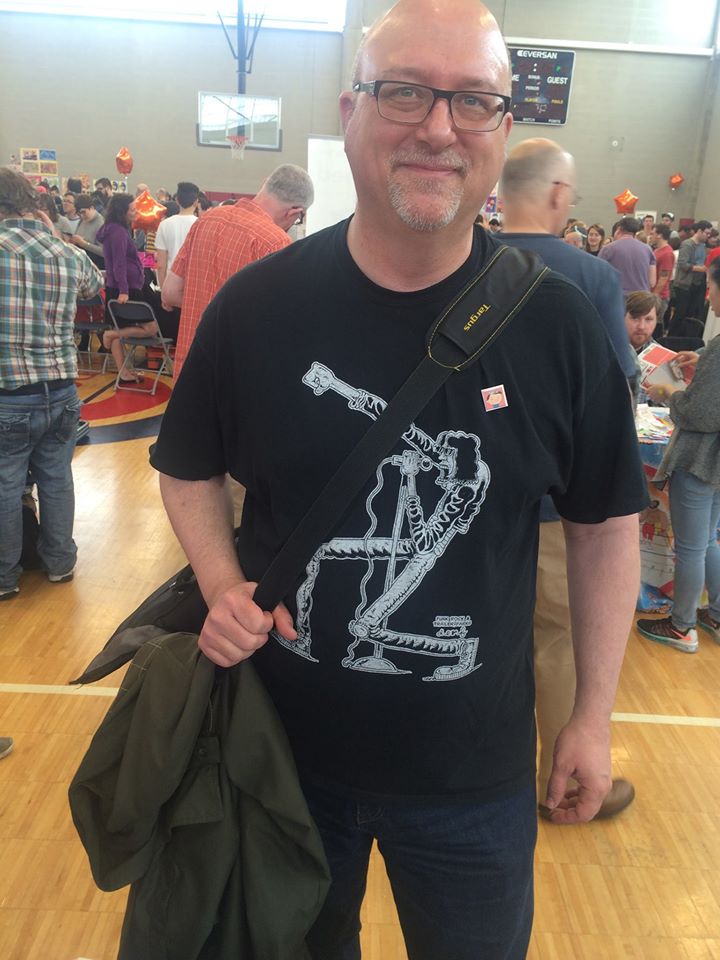 |
Gene Kannenberg Jr. in a Joey Ramone shirt.
[T-shirt design and photo by J Derf Backderf] |
I read comics off and on as a kid and then through my undergraduate years, a bit less as I entered grad school for my MA and then a PhD in medieval literature at the University of Connecticut. My first year at UConn, I met fellow grad student and comic reader
Charles Hatfield. We traded books. We went to comics shops. Being academically inclined, we talked a lot about what we read. Pretty quickly our conversations changed from “Wasn’t it cool when…?" to “Isn’t it interesting how…?”
Soon we discovered some of the academic writing that had been done about comics, primarily from a literary studies perspective. Books like Joseph Witek’s Comic Books as History had a profound influence on us. We started going to academic conferences where we met other academics who were writing about comics. UConn Prof. Tom Roberts had been teaching a course on comics for several years already and he let Charles and I guest-lecture in his course several times. Knowing smart, dedicated colleagues with similar interests really helped me see the value in doing this sort of work, and their support had a tremendous influence on my life for many years.
When did you start making comics yourself?
I tried drawing comics as a child, but my attention span was never great. Once I was writing about comics as a graduate student, I started drawing a few pages, eventually publishing a small run of “Gene Gene’s Comics Machine” in 1997. These were slice-of-life stories, dreams, illustrated song lyrics, 16 pages of a bunch of stuff. After that, I pretty much stopped drawing altogether.
One night on 2014 I decided to try again, a little more seriously. I spent all night on a page, and it wound up being seen and
blogged by Andrei Molotiu, a comics historian and artist who specializes in abstract comics. That was amazing to me! It might have been Andrei who introduced me to the term "
asemic writing” — or at least he re-reminded me that this was the tradition in which I found myself working.
I then drew another page—
an abstracted version of those old Charles Atlas ads where the bully kicks sand in the scrawny man’s face at the beach. It was purchased for publication—before it was even finished!—by Pizo Meyer, an artist and editor, for publication in his zine
Ink the Bink. That should have been great for momentum! But then I pretty much stopped drawing again.
In late 2014 I moved to Evanston, I had a lot of free time on my hands and wanted to be drawing again. I picked up my brush pen — gifted to me from my friend
Cora Lynn Deibler, an artist and professor at UConn — and sketched a comic. I said to myself, “Hey, maybe I’ll do one of these every day for a year”, a ridiculous ambition given my track record. I posted that
first drawing on Facebook, then another one and another. I started to get some real encouragement from friends on these first few drawings, and within a week I started a Tumblr blog. I called it "
Comics Machine” in homage to my minicomic of 1997. Later I put together a print minicomic of some of my favorite pages. It got mentioned as a
notable comic of 2015 by the Comics Studies Society.
Miraculously, I kept my resolution and posted a new comics page every single day in 2015, never missing a day! It got tricky because of travel. I’d need to work ahead and do more than one comic a day when I knew I’d be on the road, so that I could schedule a new comic every day.
In 2016 I slowed down a lot for the first several months, only drawing pages occasionally, but in September I had a new small sketchbook and drew a comic on the first page of it, and the drawing felt like the beginning of something longer. In another moment of impulse I decided that I would fill the notebook with one continuous abstract/asemic narrative, and I’d be done when I reached the last page. I didn’t draw every day, but I did most days, and I filled the last page sometime in November. That was
Qodèxx. I was getting a lot of great feedback on those pages, so I knew I’d need to collect it.
What prompted you to create this body of work that is so abstract and uses asemic writing?
Basically, I was making a virtue out of necessity. After reading and studying comics for so long, I felt an urge to start making comics, but I didn’t feel like I had any real stories to tell, plus I wasn’t confident in my ability to draw. So I used "words” that only looked like words, and I drew pictures that rarely ever looked like any real things at all. The language part is especially ironic because 1) My PhD is in English Literature, and 2)
one of my scholarly focuses was on comics lettering, especially how its appearance helps to influence readerly understanding. So I then go on to create comics which are aggressively non-literary, where the letter-forms are really JUST forms, with no linguistic content at all!
What's coming up next for you?
At this point, I can’t not draw comics. I’m still creating one-off, self-contained pages, though not every day, but I also want to create more long-form comics as well. I can sort of see the broad strokes of my next big project in my head. I have a general concept for the kind of drawings I want to do, and a provisional title. And I want to work at a larger scale.
Qodèxx was drawn at nearly the size it was printed; I’d like to try and explore larger spaces.
I call you the accidental comic book artist. When did you start admitting you're a comic artist?
I am self-deprecating by nature, and I also have a huge respect for cartooning as a profession — plus, I have a lot of friends who are professional cartoonists. So making a leap from writing about comics to drawing things that looked like comics did feel a bit hubristic to me at first; and honestly, it still does, a little. But once I sold my first comic a few years ago for publication, I sort of couldn’t deny it. It still feels a bit odd to call myself a cartoonist, but only out of a decades-old habit of considering myself “just” a reader or an academic or an historian. But hey, I draw pages full of panels full of the visual elements of comics. Of course I’m a cartoonist!